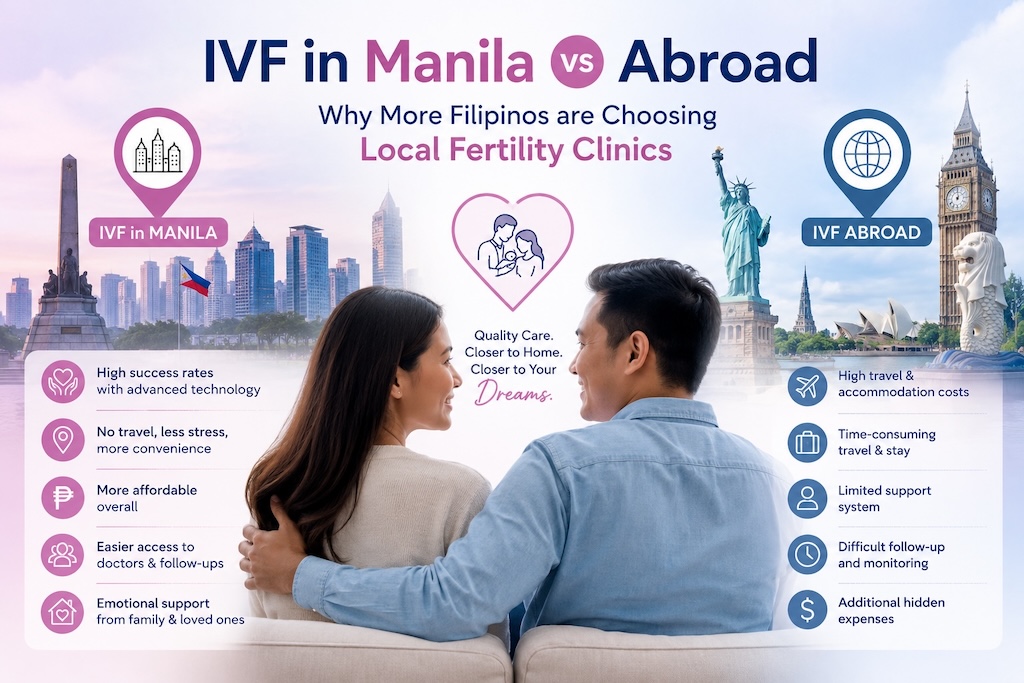
IVF in Manila vs. Abroad: Why More Filipinos Are Choosing Local Fertility Clinics
For years, many Filipino couples assumed that pursuing IVF treatment meant traveling to Singapore, Thailand, Japan, or even Europe. The perception was simple: better technology and higher success rates could only be found overseas.
That assumption is no longer accurate.
Today, IVF in Manila has reached international standards of care, with locally trained reproductive endocrinologists, world-class embryology labs, and protocols calibrated specifically for Filipino patients. Meanwhile, the hidden costs of medical tourism—financial, emotional, and logistical—are becoming increasingly apparent.
If you’re weighing a fertility clinic in the Philippines against going abroad, this honest comparison will help you make the best decision for your family-building journey.
The True Cost Comparison: Beyond the Sticker Price
Most comparisons focus solely on cycle fees. But the real cost of IVF abroad includes significant expenses that rarely appear in clinic brochures.
Direct Treatment Costs
| Expense Category | IVF in Manila (PHP) | Singapore/Thailand (Converted to PHP) |
| Base IVF Cycle | ₱350,000 – ₱500,000 | ₱600,000 – ₱900,000+ |
| Medications | ₱100,000 – ₱180,000 | ₱150,000 – ₱250,000+ |
| PGT-A Testing (per embryo) | ₱25,000 – ₱35,000 | ₱40,000 – ₱60,000+ |
| Frozen Embryo Transfer | ₱80,000 – ₱120,000 | ₱150,000 – ₱220,000+ |
Note: Prices vary by clinic and individual protocol. Always request itemized quotes.
Hidden Costs of Medical Tourism
These are the expenses that catch patients off guard:
- Travel & Accommodation: Multiple trips required (consultation, monitoring, retrieval, transfer). A single IVF cycle may require 2–3 visits of 7–14 days each. Flights + hotels can add ₱200,000–₱400,000+.
- Lost Income: Unpaid leave for both partners across multiple trips. For OFWs or professionals with limited leave credits, this can be career-impacting.
- Emergency Complications: If OHSS or other complications arise abroad, foreign hospital bills are not covered by PhilHealth or most Philippine HMOs.
- Follow-Up Care: Post-transfer monitoring, early pregnancy scans, and complication management must be coordinated across borders, often requiring additional local consultations anyway.
- Currency Fluctuations: Exchange rate shifts between booking and payment can add 10–20% to costs unexpectedly.
💡 Key Insight: When all costs are factored in, IVF in Manila typically costs 40–60% less than equivalent treatment in Singapore or Thailand, with comparable clinical outcomes.
Clinical Quality: IVF Clinics in Manila Has Caught Up
The quality gap that once existed has largely closed. Leading fertility clinics in the Philippines now offer:
Advanced Laboratory Technology
- Time-lapse embryo incubators for continuous monitoring
- Comprehensive chromosomal screening (PGT-A/M/SR)
- Vitrification with high post-thaw survival rates
- ICSI, IMSI, and assisted hatching capabilities
- Strict air quality and culture media standards matching international benchmarks
Internationally Trained Specialists
Many Filipino reproductive endocrinologists have completed fellowships at leading institutions in Australia, the UK, the US, and Japan. They bring global expertise back to Manila while maintaining deep understanding of local patient needs.
Accreditation & Standards
Reputable Manila clinics maintain PSRM membership, DOH ART licensing, and increasingly pursue international certifications. Lab proficiency testing and external quality assurance programmes ensure consistency with global standards.
The Filipino Advantage: Why Local Protocols Matter
This is perhaps the most underappreciated factor. Fertility treatment developed using Western or East Asian population data doesn’t always translate optimally to Filipino patients.
Population-Specific Considerations
- BMI & Metabolic Profiles: Filipino women have different metabolic risk thresholds; PCOS presentation and insulin resistance patterns differ from Caucasian populations
- Ovarian Reserve Patterns: AMH norms and response to stimulation medications may vary; protocols calibrated on local outcome data prevent over- or under-stimulation
- Genetic Carrier Screening: Relevant recessive conditions in Filipino populations differ from those prioritized in Western panels
- Nutritional Context: Dietary guidance based on available local foods is more sustainable and effective than imported meal plans
A top IVF centre in Manila uses its own validated outcome data to refine protocols for the population it actually serves—not borrowed benchmarks from dissimilar demographics.
Emotional & Logistical Realities No One Talks About
Fertility treatment is already emotionally demanding. Adding international travel compounds stress in ways that directly impact outcomes.
Support Systems
- Local: Family support during recovery from egg retrieval, partner attendance at appointments, familiar food and environment during the two-week wait
- Abroad: Isolation in unfamiliar settings, language barriers during sensitive conversations, inability to have loved ones present for key moments
Continuity of Care
- Local: Same doctor and nursing team throughout every cycle; seamless transition from fertility care to obstetrics upon successful pregnancy
- Abroad: Fragmented communication between foreign clinic and local OB-GYN; delayed test result interpretation across time zones; difficulty managing complications after returning home
Language & Cultural Comfort
Discussing infertility, pregnancy loss, and intimate medical procedures is profoundly personal. Doing so in your native language, within a cultural framework you share with your care team, reduces miscommunication and emotional burden. Filipino fertility nurses and counsellors understand local family dynamics, religious considerations, and social pressures in ways foreign teams cannot replicate.
When Going Abroad May Still Make Sense
We believe in honest guidance. There are specific scenarios where international treatment remains appropriate:
- Rare Genetic Conditions: Requiring specialized PGT-M panels unavailable locally
- Donor Gametes: If specific donor characteristics or legal frameworks abroad better match your needs (note: gamete donation regulations vary significantly by country)
- Complex Surgical Cases: Combined fertility-surgery cases requiring subspecialists not yet available in Manila
- Established Care Relationship: Patients who began treatment abroad mid-cycle and need continuity
For the vast majority of Filipino patients seeking standard IVF, IUI, or fertility preservation, local options now provide equivalent or superior value when total cost, convenience, and culturally competent care are considered.
Making Your Decision: Questions to Ask Yourself
Before committing to medical tourism, honestly assess:
- Can I afford 2–3 international trips without financial strain?
- Do I have adequate leave coverage for extended absences?
- Am I comfortable navigating medical communication in a second language during high-stress moments?
- Have I verified that the foreign clinic’s success rates apply to patients with my demographic profile?
- What is my contingency plan if complications arise after returning to the Philippines?
- Have I consulted a Manila-based specialist to confirm whether local treatment could achieve the same outcome?
Explore World-Class IVF in Manila at Alpha Fertility Centre
You don’t have to choose between quality and accessibility anymore. Alpha Fertility Centre Philippines offers internationally benchmarked IVF treatment with protocols optimized for Filipino patients, transparent pricing in pesos, and compassionate care rooted in local understanding.
Schedule a consultation to discuss your specific situation and receive a personalized treatment plan—with no passport required.
Disclaimer: This article is for informational purposes only and does not constitute medical advice. Individual circumstances vary. Always consult with a qualified reproductive endocrinologist before making treatment decisions. Cost estimates are approximate and subject to change.